'Death Will Have a Rich Harvest' : The Opening Days of the Hundred Days Offensive

Updated: Aug 5
‘The machine guns are singing, hand grenades are exploding – death will have a rich harvest.’ — Leutnant Stürmer

There is something so strange yet so fitting in the way people describe terror through the language of ordinary life. The popular British sitcom Blackadder demonstrates this nicely by turning the First World War into jokes about "cunning plans", impossible situations, and the hope that the whole thing might somehow be "finito".
The humour is absurd, but the instinct behind it is familiarity.
Leutnant Stürmer did the same at Amiens. Violence became music, death became a harvest. Faced with fear, destruction and the possibility of death, it is understandable that the mind would turn to what it already knows.
For Stürmer and the rest of the German army, 8 August unfolded quicker than it was understood. Guns thundered through the fog; vision reduced to dark, shadowy figures, communication failing and resistance seemed to melt away before many men had even the slightest chance to understand the gravity of the attack.
By the time anything made sense, it had already been lost.
***
By 1918, the First World War had entered its fifth year. On the Western Front, it had become associated with stalemate: vast offensives, enormous casualties and advances measured in yards rather than miles. The Somme and Passchendaele had come to symbolise the apparent futility of industrial warfare; all that bloodshed, for what?

As another year of fighting began, something had to change. The armies could not continue repeating the same costly methods and expect different outcomes.
On the chessboard of war, Germany made the first move.
Russia’s withdrawal from the war allowed German divisions to be transferred west, giving General Erich Ludendorff a brief opportunity to strike before growing numbers of American troops could alter the balance. Beginning on 21 March 1918, the German Army launched a series of major offensives intended to divide the British and French forces.
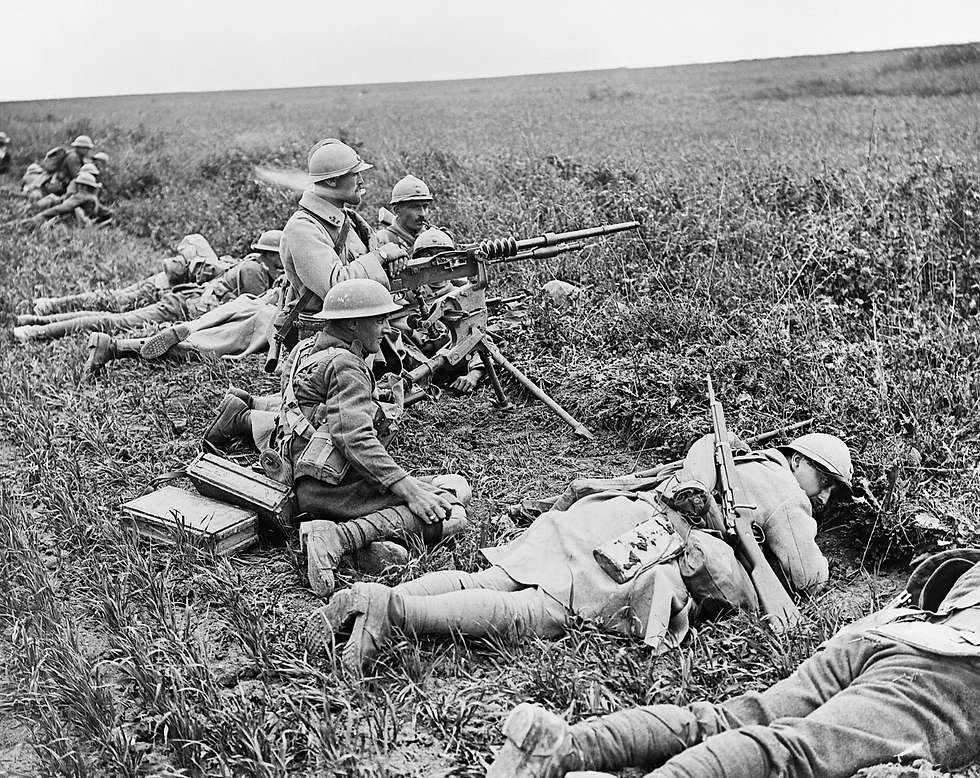
At first, the attacks seemed devastatingly successful. German troops broke through British positions and advanced across ground that had been surrendered at enormous cost. The old front lines shifted, Allied communications came under threat, and Amiens itself appeared vulnerable. For a moment, it looked like checkmate.
Yet the offensives failed to secure a decisive victory. In fact, they weakened the very army they were intended to save. Germany had captured territory, but at the cost of many of its most experienced troops.
Meanwhile, the Allies had been preparing their response. This would be a plan that would change the course of the war.
***
Under Marshal Ferdinand Foch’s direction, General Sir Henry Rawlinson’s Fourth Army prepared to strike east of Amiens alongside General Marie-Eugène Debeney’s French First Army. At the centre of Rawlinson’s force were John Monash’s Australian Corps and Arthur Currie’s Canadian Corps. Their reputations for successful assaults made them valuable, but dangerous to reveal. If the Germans discovered that they were moving towards Amiens, the plan might unravel before a single shot was even fired.
So their arrival was hidden.
Selected Canadian units, wireless equipment and medical facilities were sent north towards Flanders, creating the impression that Currie’s men were preparing to attack elsewhere. Under the cover of darkness, the main force moved into position. Thousands of soldiers, more than 2,000 guns and hundreds of tanks gathered behind the front.
There was no prolonged bombardment. No warning barrage. Rawlinson had rejected the methods that had announced so many earlier offensives. German batteries had already been located through aerial observation, sound ranging and flash spotting. The guns did not need to reveal themselves by firing registration rounds. In fact, they would remain silent until Zero Hour.
***
Before dawn on 8 August 1918, British, Australian and Canadian soldiers waited in the fog. To the south, Debeney’s French troops prepared to join them.
Then, at 4.20 a.m., more than 2,000 guns opened fire. Almost 100,000 men advanced behind a creeping barrage across a front more than thirteen miles wide.

Heavy Mark V tanks crossed trenches, crushed wire and attacked machine-gun positions. Faster Whippets advanced to exploit any opening. Each machine had a purpose; none could hold the battlefield alone.
The advance unfolded in three carefully timed ‘bounds’, allowing troops to pause, consolidate and pass fresh formations forward towards the next objective.
By nightfall, Allied forces had advanced as far as eight miles in some sectors. German casualties were staggering. The official history estimated that German losses were as high as 48,000 men, including 33,000 missing or taken prisoner. Ludendorff later called 8 August the German Army’s 'black day'.
Yet the reality was less neat.
Indeed, German soldiers surrendered in large numbers, units lost contact, and reports of disorder reached an alarmed high command. But the German Army was not destroyed.
In fact, the Allied attack was already losing momentum. Artillery struggled to keep pace, infantry grew tired and German units reorganised. The tanks were tiring too. Of roughly 400 committed on 8 August, only 150 were ready the next day. By 10 August, just 85 remained.
The success of the first day at Amiens could not be sustained. Nonetheless, the Allies continued the relentless pressure through a series of attacks across the Western Front, denying the German army sufficient time to recover. This would become the pattern of the Hundred Days Offensive.
***

We know that the war ended three months later; the men advancing through the fog did not. They could not see the Armistice waiting at the end of the story, only the barrage ahead, the tanks beside them and whatever might lie beyond the next field.
That is the trick hindsight plays. To you and me, Amiens looks like the beginning of the end. To those living through it, it was simply another morning in which the world had erupted before breakfast.
Thus, while Blackadder draws on that distinctly British instinct to meet disaster with humour, where every plan is “cunning”, and the war might somehow become “finito”, at Amiens the British plan really was cunning: secretive, deceptive and precisely timed. Yet 8 August offered no comic distance from what followed.
For many, the joke would never come.
Further Reading:
The following works informed this article and offer further insight into the Battle of Amiens, the Hundred Days Offensive and the way the final months of the First World War have been remembered:
Jonathan Boff, Winning and Losing on the Western Front: The British Third Army and the Defeat of Germany in 1918 (Cambridge University Press, 2012).
J. P. Harris, Douglas Haig and the First World War (Cambridge University Press, 2008).
Nick Lloyd, Hundred Days: The End of the Great War (Viking, 2013).
Douglas Haig, The Private Papers of Douglas Haig, 1914–1919, ed. by Robert Blake (Eyre & Spottiswoode, 1952).
Imperial War Museums, resources on the Battle of Amiens and the Hundred Days Offensive.
The History of the Great War Podcast, ‘The Hundred Days Offensive’, Parts 1–9.
Blackadder Goes Forth, created by Richard Curtis and Ben Elton (BBC, 1989).

Comments